
The modern data stack has fundamentally changed how organizations think about data transformation. At the center of this shift sits dbt (data build tool), a framework that has rapidly become the standard for how data teams build, test, and document their transformation pipelines. For enterprises running legacy ETL platforms, understanding dbt is no longer optional — it is the destination that most migration roadmaps now point toward.
This article explains what dbt is, why it has gained such momentum, and how MigryX enables organizations to migrate from legacy platforms to production-ready dbt projects without manual rewrite.
What Is dbt?
dbt (data build tool) is a SQL-first transformation framework that enables data teams to apply software engineering practices — version control, testing, documentation, and CI/CD — to their data pipelines. Instead of drag-and-drop ETL interfaces or proprietary scripting languages, analysts and engineers write SELECT statements, and dbt handles the rest: dependency management, incremental builds, and documentation generation.
At its core, dbt is deceptively simple. A dbt "model" is a SQL file containing a single SELECT statement. dbt compiles that statement into a CREATE TABLE or CREATE VIEW (depending on configuration), resolves dependencies between models using the ref() function, and executes them in the correct order against your data warehouse. What makes this powerful is not the individual model — it is the system that emerges when hundreds or thousands of models are managed as a single, version-controlled project.
dbt does not extract or load data. It operates exclusively on data that already exists in the warehouse. This narrow scope is intentional: by doing one thing exceptionally well — in-warehouse transformation — dbt avoids the complexity bloat that plagues general-purpose ETL tools.

dbt — enterprise migration powered by MigryX
The ELT Paradigm Shift
Traditional ETL tools extract data from source systems, transform it on a dedicated server, then load the results into a data warehouse. This pattern made sense when warehouse compute was expensive and limited. Organizations paid for transformation servers precisely because running complex logic inside the warehouse was cost-prohibitive.
Cloud data warehouses changed the economics entirely. Platforms like Snowflake, BigQuery, and Databricks offer elastic compute that scales on demand. Running transformations inside the warehouse is now cheaper and faster than maintaining separate transformation infrastructure. This inversion gave rise to ELT: extract, load, then transform.
In the ELT pattern, raw data lands in the warehouse first via ingestion tools like Fivetran, Airbyte, Stitch, or custom pipelines. Once the data is in the warehouse, dbt transforms it in-place using the warehouse's own compute engine. This eliminates the need for dedicated transformation servers, reduces data movement, and leverages the elastic scaling that cloud warehouses provide natively.
The ELT shift is not merely a technical rearrangement. It changes who can write transformations. Because dbt uses SQL — the lingua franca of data — analysts who previously depended on engineering teams to implement transformation logic can now build and own their own pipelines. This democratization has been one of the key drivers of dbt's adoption.
MigryX: Idiomatic Code, Not Line-by-Line Translation
The difference between MigryX and manual migration is not just speed — it is code quality. MigryX generates idiomatic, platform-optimized code that leverages native features of your target platform. A SAS DATA step does not become a clunky row-by-row loop — it becomes a clean, vectorized DataFrame operation. A PROC SQL query does not become a literal translation — it becomes an optimized query that takes advantage of your platform’s pushdown capabilities.
dbt Core vs. dbt Cloud
dbt exists in two forms, and understanding the distinction matters for migration planning.
dbt Core is the open-source command-line tool. It is free, runs anywhere Python runs, and provides the full compilation, execution, and testing engine. Teams using dbt Core manage their own scheduling (typically via Airflow, Dagster, or cron), their own CI/CD pipelines, and their own documentation hosting.
dbt Cloud is a managed platform built on top of dbt Core. It adds a web-based IDE for developing models in the browser, built-in job scheduling with monitoring and alerting, CI/CD integration that tests pull requests against a staging environment, a semantic layer for defining metrics once and querying them from any BI tool, and Explorer, an interactive lineage visualization tool.
Both produce the same dbt project structure — models, tests, macros, snapshots, seeds, and exposures. Code written in dbt Cloud runs identically in dbt Core, and vice versa. MigryX-generated dbt projects are compatible with both environments, giving organizations flexibility in how they choose to operate.
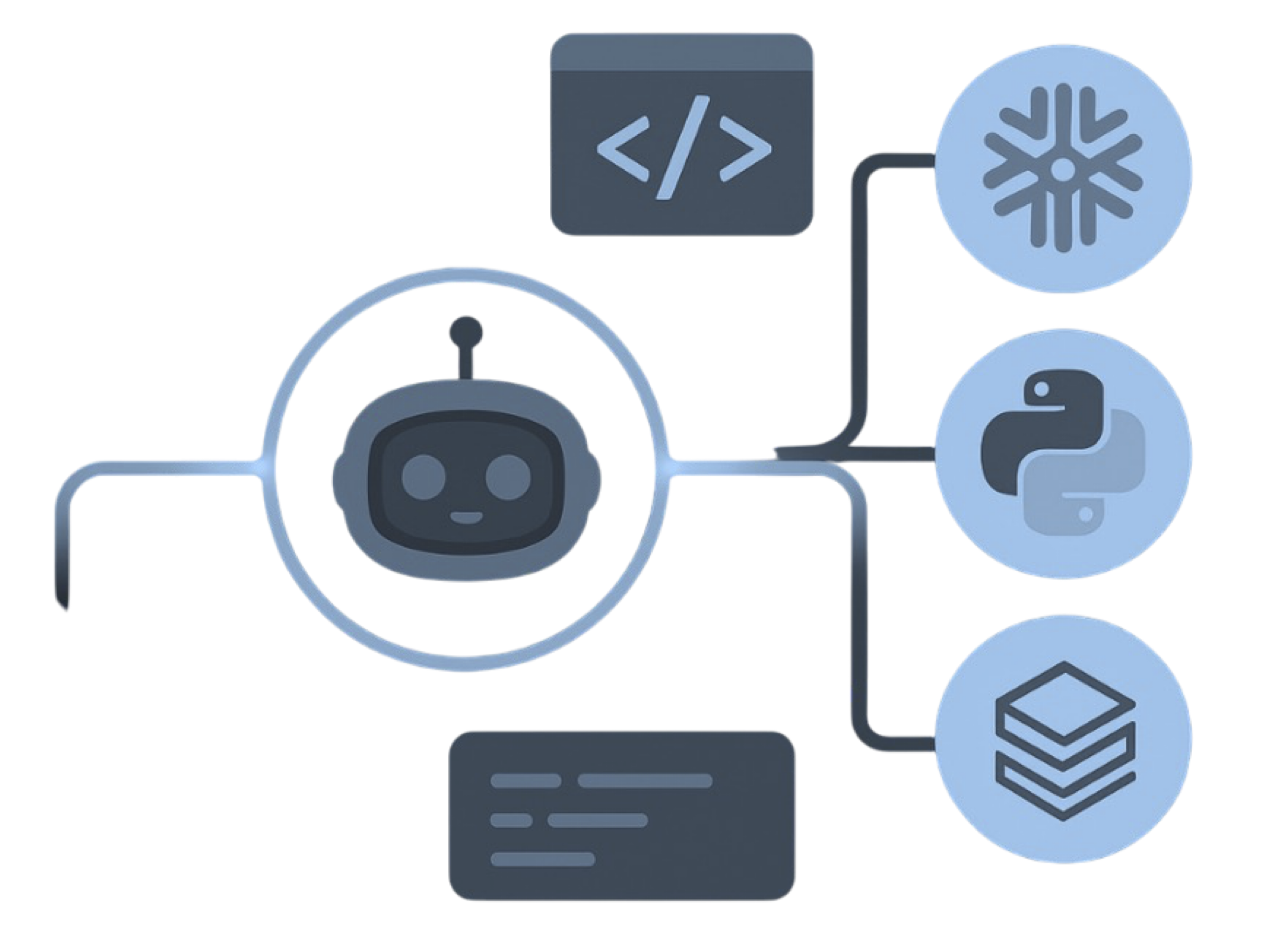
MigryX precision parser — Deep AST-level analysis ensures every construct is understood before conversion begins
Platform-Specific Optimization by MigryX
MigryX maintains deep knowledge of every target platform’s strengths and best practices. When converting to Snowflake, it leverages Snowpark and native SQL functions. When targeting Databricks, it uses PySpark DataFrame operations optimized for distributed execution. When generating dbt models, it follows dbt best practices for modularity and testability. This platform awareness is what makes MigryX output production-ready from day one.
Key dbt Concepts
A dbt project is composed of several interconnected components. Understanding these concepts is essential for evaluating how legacy constructs map to the dbt world.
- Models — SQL files containing
SELECTstatements. Models reference other models viaref('model_name')and external tables viasource('schema', 'table'). Each model materializes as a table, view, incremental table, or ephemeral CTE based on its configuration. - Tests — Assertions about your data. Schema tests (defined in YAML) check properties like
unique,not_null,accepted_values, andrelationships. Custom data tests are standalone SQL queries that return rows when the assertion fails. - Macros — Reusable SQL snippets templated with Jinja. Macros can accept parameters, include conditional logic, and call other macros. They serve the same role as SAS macros or Informatica reusable transformations, but with full version control.
- Snapshots — Implement Slowly Changing Dimension Type-2 (SCD-2) tracking. dbt snapshots capture how a source row changes over time by maintaining
dbt_valid_fromanddbt_valid_tocolumns. - Seeds — CSV files stored in the dbt project repository and loaded into the warehouse as tables. Seeds are ideal for small reference datasets like country codes, status mappings, or business calendars.
- Exposures — Declarations of downstream consumers (dashboards, ML models, APIs) that depend on dbt models. Exposures complete the lineage picture by documenting what happens after data leaves the warehouse.
- Sources — Definitions of external tables that dbt reads from but does not manage. Sources support freshness monitoring, alerting you when upstream data is stale.
Why dbt Is Winning in Modern Data Teams
dbt's adoption has accelerated because it solves problems that legacy ETL tools either ignored or solved poorly. Several factors explain its dominance.
Version control for every transformation. Every dbt model is a file in a Git repository. Changes are tracked, reviewed via pull requests, and rolled back when needed. Legacy ETL tools store transformation logic in proprietary metadata databases that resist diffing, branching, and code review.
Automated documentation that never goes stale. dbt generates a documentation website directly from your project. Model descriptions, column descriptions, and the dependency graph are all derived from the code itself. When the code changes, the documentation updates automatically. In legacy environments, documentation is a separate artifact that drifts out of sync within weeks.
Built-in testing catches data quality issues before they reach dashboards. dbt tests run as part of every pipeline execution. A failing test halts the pipeline, preventing bad data from propagating downstream. Legacy platforms require bolted-on data quality tools or manual spot checks that miss issues until business users report them.
The ref() system builds a dependency graph automatically. When a model references another model via ref(), dbt knows that the referenced model must run first. This eliminates manual dependency configuration — a common source of errors in tools like Informatica and DataStage where developers must manually wire execution order.
CI/CD integration means PRs are tested against real data before merge. dbt Cloud (and dbt Core with custom CI) can run a pull request's models and tests against a staging schema before the code is merged. This catches transformation errors during code review, not in production at 2 AM.
The cumulative effect of these capabilities is a development experience that feels more like building a software application than configuring an ETL tool. For organizations accustomed to the friction of legacy platforms, the difference is transformational.
How MigryX Generates Production-Ready dbt Projects
Migrating to dbt is the right strategic decision for most organizations running legacy ETL platforms. The challenge is not the destination — it is the journey. Converting thousands of SAS programs, Informatica mappings, DataStage jobs, or Talend pipelines into well-structured dbt projects is a massive undertaking when done manually.
MigryX automates this conversion end-to-end. The platform's parsers build complete abstract syntax trees for every supported source language, then the conversion engine translates each construct into its dbt equivalent following community best practices.
The output is not a pile of SQL files. MigryX generates a complete, structured dbt project:
- Staging models with
source()references that mirror raw tables with consistent naming, type casting, and column aliasing. - Intermediate models that encapsulate business logic — joins, filters, aggregations, and conditional transformations — translated from legacy code.
- Mart models for analytics-ready datasets that downstream dashboards and reports consume.
- schema.yml files with tests (
unique,not_null,accepted_values,relationships) generated from legacy validation logic and source metadata. - Jinja macros translated from legacy macro systems (SAS macros, Informatica reusable transformations, DataStage shared containers).
- Snapshots for any SCD patterns detected in the legacy code.
MigryX dbt Output
MigryX generates complete dbt projects — staging/intermediate/mart models, Jinja macros, schema tests, snapshots, and documentation — from any legacy ETL source, following dbt community best practices.
The result is not a first draft that requires extensive rework. It is a production-ready dbt project that passes dbt build, generates clean documentation, and follows the naming conventions and structural patterns that the dbt community has established. Engineers review and refine rather than write from scratch, cutting migration timelines by 60-80% compared to manual rewrite.
For organizations evaluating dbt as their transformation layer, MigryX removes the primary barrier to adoption: the cost and risk of converting legacy assets. The framework is modern, the community is thriving, and the tooling to get there is now automated.
Why MigryX Delivers Superior Migration Results
The challenges described throughout this article are exactly what MigryX was built to solve. Here is how MigryX transforms this process:
- Production-ready output: MigryX generates code that passes code review and runs in production — not prototype-quality output that needs weeks of cleanup.
- Platform optimization: Converted code leverages target platform-specific features for maximum performance and cost efficiency.
- 25+ source technologies: Whether migrating from SAS, Informatica, DataStage, SSIS, or any of 25+ legacy technologies, MigryX handles it.
- Automated documentation: Every conversion decision is documented with before/after code mappings and transformation rationale.
MigryX combines precision AST parsing with Merlin AI to deliver 99% accurate, production-ready migration — turning what used to be a multi-year manual effort into a streamlined, validated process. See it in action.
Ready to migrate to dbt?
See how MigryX automates legacy-to-dbt conversion with precision, speed, and trust.
Schedule a Demo